


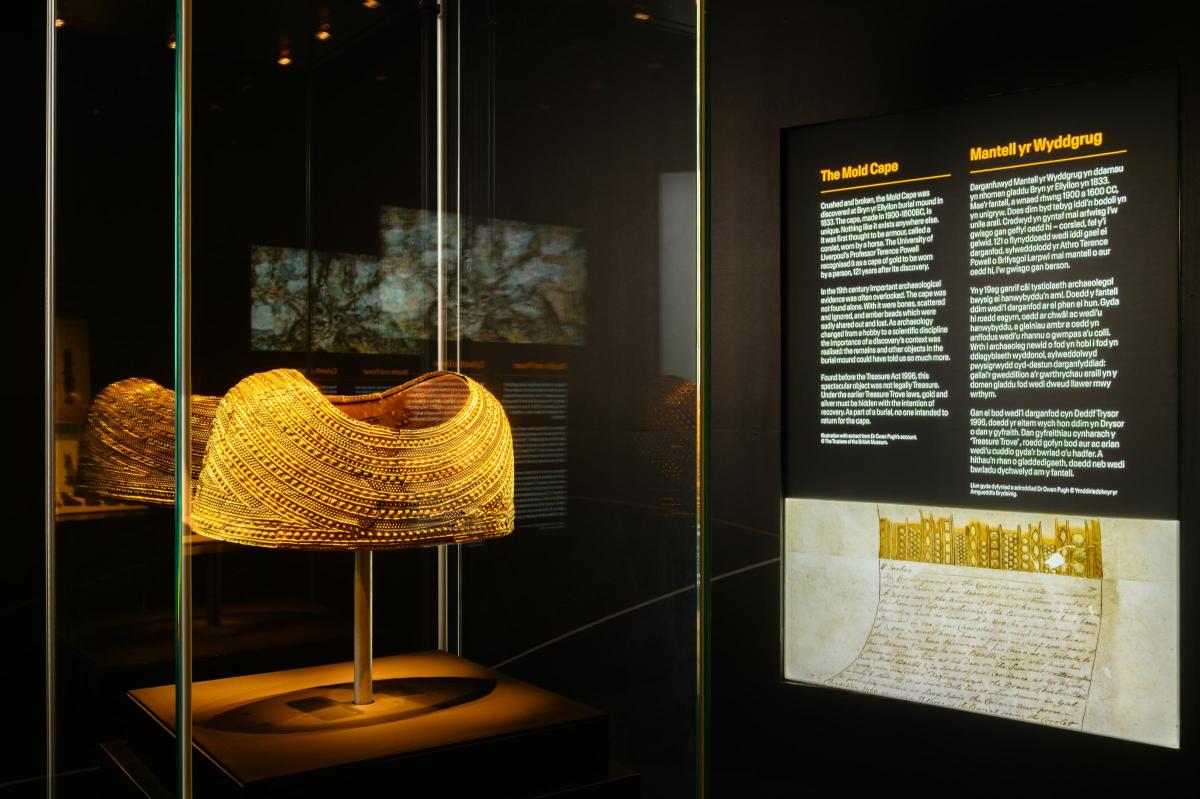

A REMARKABLE Bronze Age discovery from Mold has taken pride of place in a major new exhibition in Liverpool.
Archaeological finds from North Wales are being brought together at a new exhibition at the Museum of Liverpool bringing together significant discoveries from Merseyside, the North West and Wales.
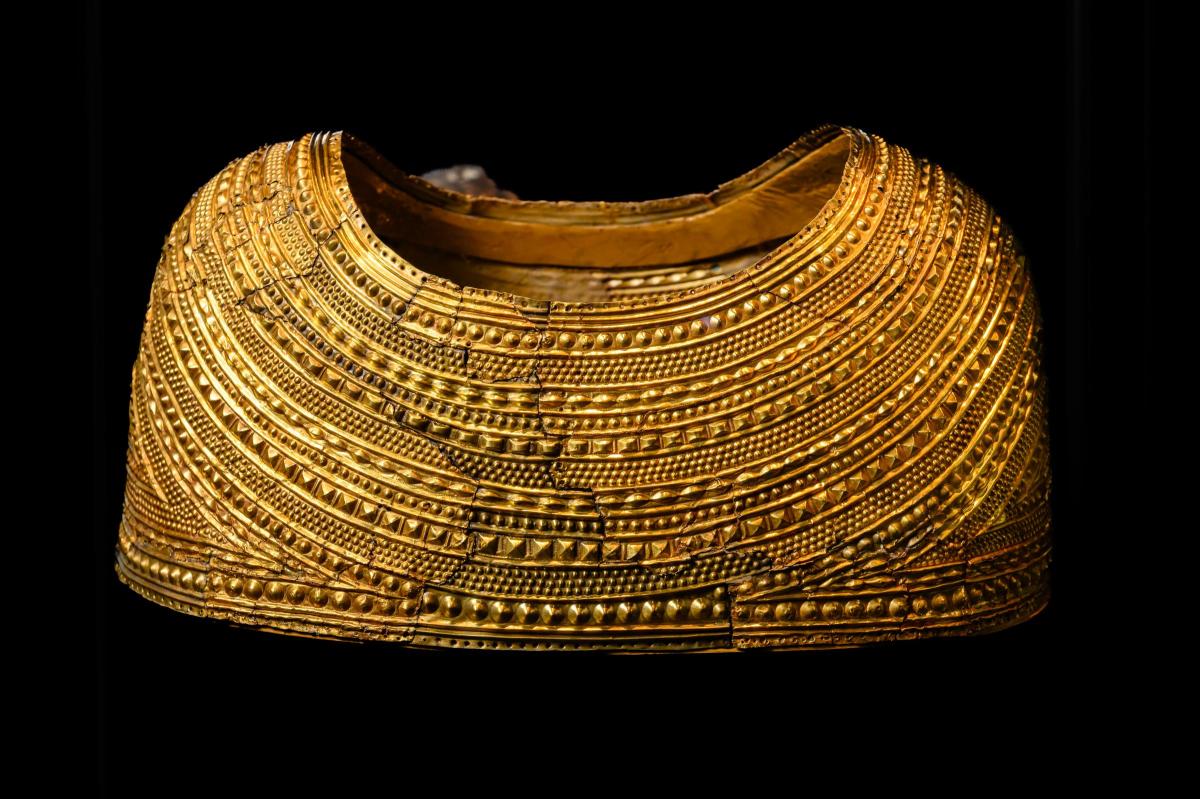
The artefact is a gold cape, discovered in 1833 at Bryn yr Ellyllon in Mold and later recognised as one of the most important Bronze Age objects ever found in Britain. Now loaned from the British Museum, it forms the centrepiece of Treasure: History Unearthed.
Made between 1900 and 1600BC, the cape was uncovered crushed inside a burial mound.
Early on, people thought it was armour for a horse, but it wasn’t until more than a century later that Professor Terence Powell from the University of Liverpool identified it as a ceremonial gold cape made to be worn by a person.

Its discovery was poorly recorded. Human bones were ignored and the amber beads found with it were shared out and lost.
Despite weighing more than 700 grams, the gold was hammered into a thin sheet decorated with patterns and shaped to fit over the shoulders.
It would have restricted movement, suggesting it was worn only for rituals or ceremonies.
Research carried out during conservation work now shows it would have fitted a small woman or teenager, contradicting the long-standing assumption that it belonged to a male figure of high status.
Because it was found long before the Treasure Act, the cape was not legally considered Treasure at the time.
Under the old Treasure Trove rules, only objects deliberately buried for later recovery qualified — and as a burial item, the cape did not.
Ahead of the exhibition, the Museum of Liverpool worked with Mold Museum, holding community events for residents who were among the first to be told that the cape would be loaned and displayed close to home.
The exhibition is fully bilingual in English and Welsh and highlights the longstanding cultural and historical connections between North Wales and Liverpool.
Alongside the cape are other Welsh objects from the Bronze Age, loaned by National Museums Wales and Wrexham County Borough Museum.
The display also explores the role of the Portable Antiquities Scheme, whose Finds Liaison Officers regularly record archaeological discoveries made in Flintshire and across North Wales by metal detectorists, walkers and members of the public.
Treasure: History Unearthed runs at the Museum of Liverpool until March 29, 2026 and includes curator tours, talks and hands-on activity days.
For Mold, it marks the return of a piece of its past and a rare chance to see one of Wales’ most extraordinary archaeological finds shown as part of a wider story about the region’s history.


Share